Contractor SEO built around real services, real locations, and estimate requests.
Patrick SEO Content & Website Solutions helps contractors and home-service businesses build clearer local websites around the work customers actually search for. The strategy connects service pages, project types, materials, service areas, city content, project proof, Google Business Profile activity, and stronger estimate pathways.
Connect the service, property need, location, proof, and estimate path.
Contractor searches often combine a service, project type, material, property condition, city, and urgency level.
Contractor SEO is not one services page repeated across dozens of cities.
Homeowners and property managers search by problem, service, material, project type, property condition, location, timing, and urgency. A contractor website needs enough detail to explain the work, show local relevance, establish trust, and guide the visitor toward an estimate without publishing repetitive or unsupported content.
Contractor websites often lose clarity before they lose traffic.
The site may technically exist and still make it difficult for customers to understand the services, service area, project proof, qualifications, or next step.
One Broad Services Page
Distinct installations, repairs, replacements, and specialty services are compressed into short paragraphs with little practical detail.
Duplicate City Pages
Service-area pages repeat the same copy with only the city name changed and provide little local usefulness.
Weak Project Proof
The site lacks completed-project details, before-and-after examples, materials, property types, reviews, or visible evidence of the work.
Unsupported Claims
Licensing, insurance, warranties, certifications, timelines, and guarantees are vague, outdated, or published without confirmation.
Poor Estimate Path
Customers do not know what photos, measurements, property details, urgency, or project information to provide.
Disconnected GBP & Website
The profile lists services with no useful supporting pages, or the website does not match the profile’s service area and categories.
Build the website assets that support local project and estimate intent.
The exact scope depends on the current website, services, platform, service area, project proof, and business information available for approval.
Strengthen the service and estimate pages before publishing generic advice.
Helpful articles can support the site, but they should connect to strong commercial pages. For many contractors, the priority is a clearer homepage, dedicated service pages, genuine local coverage, useful project proof, and an estimate process that works on mobile.
Organize the website around the work customers are trying to hire.
The page map should match the contractor’s real services, service area, proof, and estimate process.
Local SEO content adapted to the trade, property, and customer decision.
Each industry requires different service facts, terminology, proof, safety considerations, preparation, and estimate information.
Concrete Contractors
Driveways, patios, sidewalks, foundations, stamped concrete, repairs, sealing, removal, commercial work, and material choices.
Roofing & Exterior Contractors
Inspections, repairs, replacements, storm damage, materials, gutters, siding, masonry, chimneys, and exterior planning.
Plumbing & Sewer Services
Emergency problems, drain cleaning, sewer inspections, hydro jetting, repairs, replacement options, and response expectations.
HVAC & Indoor Air Services
Installation, repair, maintenance, air ducts, dryer vents, indoor-air concerns, efficiency, seasonal demand, and scheduling.
Builders & Remodelers
Custom homes, additions, renovations, project phases, design decisions, materials, timelines, consultations, and responsibilities.
Restoration & Specialty Trades
Water, fire, mold, cleanup, emergency response, specialty repair, documentation, insurance coordination, and safety boundaries.
Examples of service-area website and content projects.
These examples demonstrate website structure, service pages, local coverage, forms, content migration, internal links, and quality-control work. They are not unsupported ranking or revenue claims.
Noble Homes
Custom-home and construction content involving service positioning, local relevance, page optimization, trust content, and consultation pathways.
- Construction service content
- East Texas local relevance
- Trust and consultation paths
Wylie Concrete Kings
Page-by-page website migration and local contractor structure covering residential and commercial concrete services, forms, legal pages, service areas, and URL preservation.
- Service page hierarchy
- Local coverage and contact flow
- Migration and quality control
DeSoto Concrete Kings
Local contractor website work centered on concrete services, page structure, service-area content, conversion paths, forms, and page-by-page rebuild requirements.
- Concrete service pages
- Local service-area structure
- Form and page QA
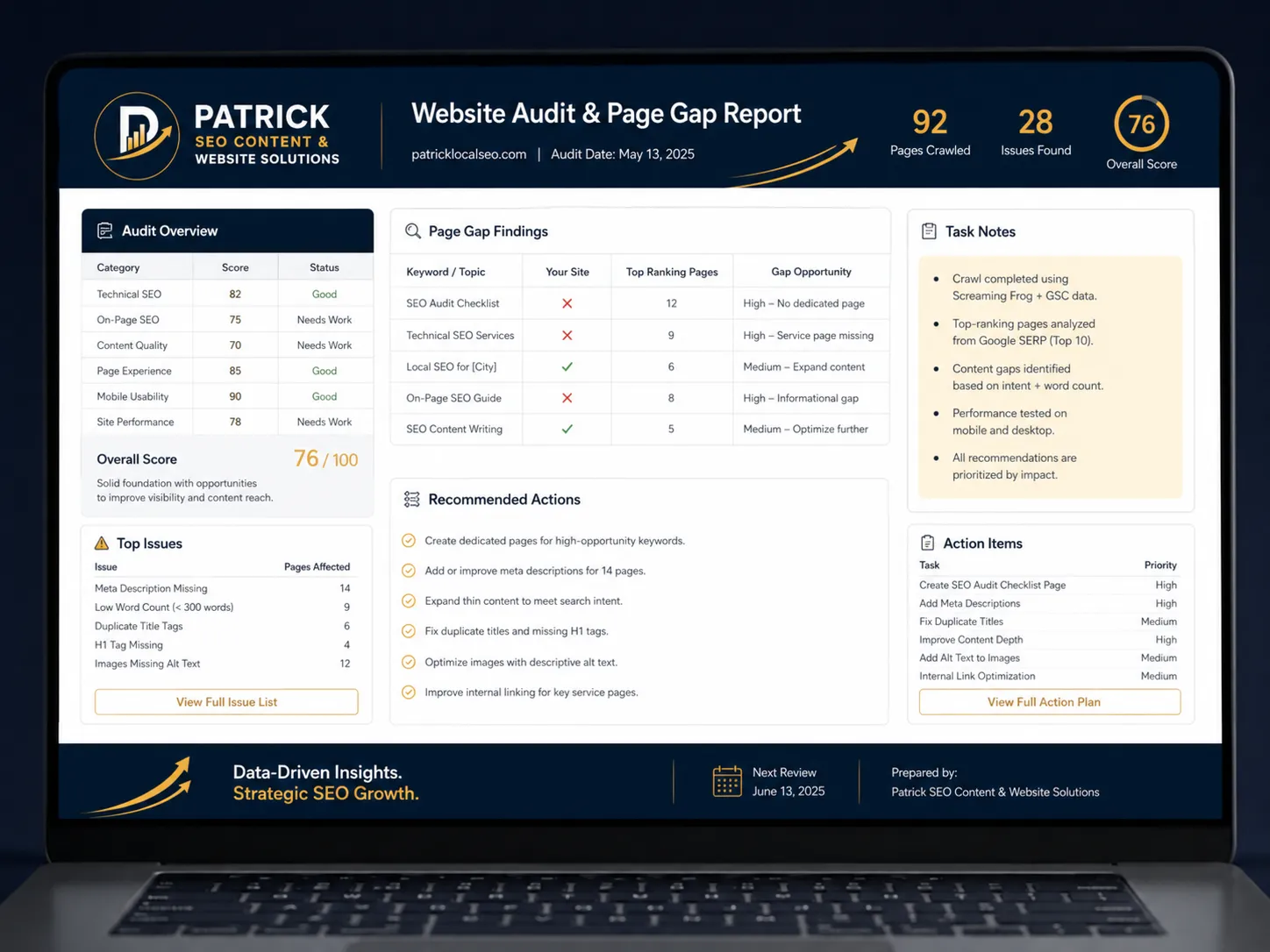
Contractor Page-Gap Planning
Audit and planning work that identifies missing services, weak local coverage, overlapping pages, proof gaps, internal-link opportunities, and priorities.
- Service and city gaps
- Content and trust priorities
- Implementation sequence
Practical assets tied to the website, service area, and estimate process.
The project can begin with an audit, content phase, implementation sprint, or custom proposal.
Recommended service, subservice, city, project, trust, and supporting pages organized by priority.
New or refreshed pages with service details, local context, proof, FAQs, internal links, and estimate CTAs.
Profile topics and website connections between services, cities, projects, reviews, blogs, and estimate pathways.
A practical sequence for corrections, core pages, local work, proof, supporting content, and optional expansion.
A structured path from business facts and website gaps to completed local assets.
Accurate contractor content depends on real services, materials, project types, service areas, policies, approvals, qualifications, and estimate requirements.
Review
Check the website, services, locations, proof, Google Business Profile, forms, links, content depth, and known constraints.
Map
Organize priority service, city, project, trust, and supporting pages around real customer and estimate intent.
Create
Write or refresh approved content, metadata, FAQs, links, GBP topics, trust sections, and estimate pathways.
Verify
Check implementation, forms, links, mobile layout, business facts, schema, visible content, and the next priority.
Contractor content must be based on approved operational facts.
Missing details should be requested rather than invented, especially licensing, insurance, warranties, prices, timelines, emergency availability, service areas, materials, financing, and project results.
Local SEO can strengthen the website and profile, but it cannot guarantee estimates, rankings, or revenue.
Results also depend on competition, reviews, authority, demand, pricing, availability, service quality, response speed, project proof, location, and search systems. The work focuses on accurate pages, clearer structure, useful local content, stronger trust, and better estimate pathways.
Questions about local SEO for contractors.
What should a contractor optimize first?
The homepage, core service pages, service-area coverage, estimate path, project proof, reviews, profile alignment, and internal links usually deserve review before large amounts of blog content are added.
Does every contractor service need a separate page?
No. A separate page is useful when the service has distinct customer intent, scope, project conditions, materials, questions, or estimate needs.
Should contractors create a page for every city?
No. City pages should be limited to genuine service areas and contain useful, distinct local information rather than repeated copy.
What proof should a contractor website include?
Useful proof can include approved reviews, completed-project examples, before-and-after images, materials used, property type, process details, and verified qualifications.
Can Google Business Profile content support contractor SEO?
Yes. Posts can rotate services, project types, maintenance, warning signs, completed work, service areas, preparation, and estimate calls to action.
Can you improve an existing contractor website?
Yes. Existing pages can be reviewed for missing services, thin local content, unclear headings, weak proof, outdated claims, broken forms, poor mobile layouts, and weak links.
What information is needed to write contractor content?
Useful inputs include the real services, materials, project types, service areas, estimate process, reviews, project examples, warranties, licenses, insurance information, and approved claims.
Does contractor SEO guarantee more leads?
No. Local SEO can improve coverage, clarity, relevance, structure, trust, and estimate pathways, but leads also depend on demand, competition, reviews, authority, pricing, availability, and service quality.
Want a clearer local website plan for your contracting business?
Send the website, primary services, service areas, project types, current Google Business Profile, and the problems you want to solve. The review can identify missing pages, weak local coverage, content gaps, project-proof needs, internal links, and the best starting point.